Asian American Subversion

When I first got an iphone, I thought emojis were kind of dumb. That’s usually an indicator for something becoming fantastically popular. When Apple introduced colored emojis, I thought it was an easy compromise for inclusion that would be obviously seen for what it is. I mean, we started with Simpsons yellow and no one is yellow skinned, right?

I am yellow skinned.

But my preferred colored emoji was the lightest skin one. After all, I wasn’t that tan. In my mind, my skin color matched the color of the emoji I chose. And that connection seemed to be simply good. I didn’t have any black friends to text me black emojis, but the occasional black Santa would appear out of humor or fun.

I started thinking about color identity post college, especially around dating. When I was younger, I had a much more selective dating profile and as I grew older and met more people of different cultures, I became less picky and more exposed to interracial interactions. Younger me hung out and interacted with people of different races and cultures. But there’s something about dating, the intimacy and the closeness of it, which allows more expression and interpersonal interpretation.

The most surprising thing was discovering this with other Asian Americans. When I moved to California, my dating pool of Asian women increased dramatically from what I was used to in Chicago. The culture in California is much more Asian influenced, measured simply by the density of boba shops.

More than one other Asian American texted me using the fairest skinned emojis. At this point in my texting career, I had gone back to the default Simpsons yellow of emojis. After all, it was the default one and I should be proud to be Asian, right? I would receive fair skinned emojis from white girls and Asian girls alike. Were the women I was texting experiencing the same American bias I had once expressed?

In modern Eastern cultures, fair skin is seen as a luxury, being able to avoid the sun or any arduous labor. Pale skin on men and women is found to be attractive. It could be seen as a form of white washing, having Asian skin snow white. It’s hard to say if this look translates to all Western Asian women, if their ideals of beauty are mixed influenced or dominantly influenced by one culture more than the other.

What I can say without a doubt as a designer is that it takes more than 0 steps to customize an emoji expression and this applies to emojis individually, meaning users must repeatedly and consciously make the decision to customize their emoji colors with each different emoji. And with that in mind, why wouldn’t I own up to having “yellow” skin and being the only race able to use the default emoji color? This alone confirms my suspicion that the Asian identity in America is to be as inconspicuous as possible. To be the model citizen is wear the skin of highest class.

Rù Xiāng Suí Sú 入乡随俗 is a Chinese idiom which literally translates to Enter Village Follow Custom. We may understand it as When in Rome, do as the Romans do. I have significant doubts as to whether the girls I went on dates with knew of these ancient wisdoms. What I can say undoubtedly is that the culture of blending in is ingrained deeply into the Asian American identity, from first generation immigrants like my parents to California natives I’ve met who are third generation and their mother tongue escapes them.

The identity I find myself most closely identifying to in America is not other Asian Americans. Sometimes the closer I get with other Asians, the more alienated I feel with myself. This is coming from someone who has gone back to China several times, whose parents prefer to speak Chinese at home. It feels strange to say the most close I feel to identifying with others is with other white guys. And I can clearly see this in my younger brother, who loved his white dominated college fraternity. It’s something I saw in the dating market and it’s something I see that is not unique to Asian culture – the idea of blending into American culture.

It’s been easier to accept and embrace my Asian identity as I’ve gotten older, especially with more media sourcing talent and stories from around the world. I believe Asian pride and expression will rise, but remain capped by it’s national and local popularity. I can say this about all cultures and minorities around the world. But how many other races have to take one extra step to remove themselves from their “yellow pride” to customize their emoji? Every time you get a text with a thumbs up, a prayer hands, or the occasional middle finger, remember the user on the other side had to pick their color and that color says something about them.

Endings and Beginnings

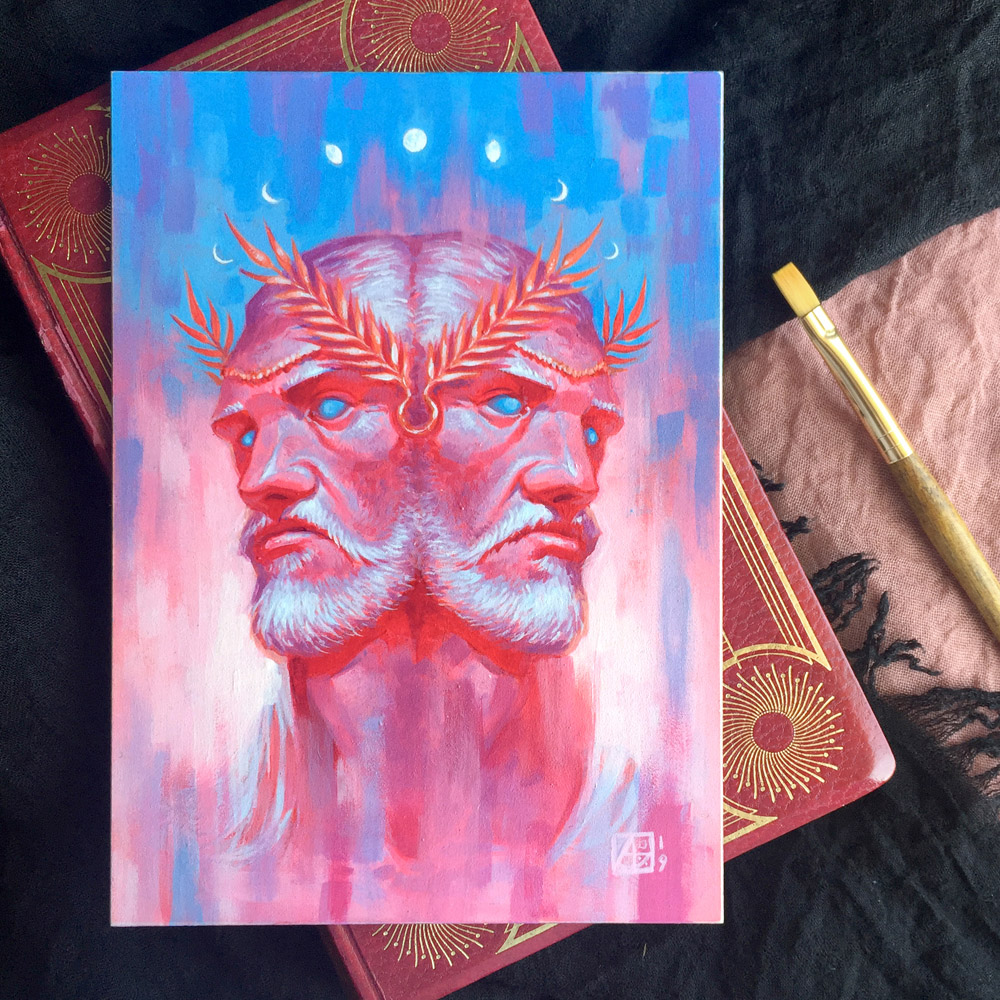
Art by Alex Stone

January didn’t always mark the beginning of our calendars. In Roman culture, March represented the beginning of the year due to it’s great weather for planting season and marching for wars, hence the name. The Gregorian calendar we are familiar with changed the start of the year from March to January.

Janus is the Roman deity of beginnings, gates, thresholds, doorways, endings, etc. He was invoked and honored in all beginnings. We can see his ceremony and practice today with ribbon cuttings, proposals, baby showers, and New Year’s resolutions. Our shared celebration of beginnings is an important shared one, for we can all experience a passage and transition together.

Janus is represented with two faces, one looking into the past and one looking into the future. When we reflect upon the past, we use the term ruminate. When we learn about the future, we use the term illuminate. Janus was responsible for the beginning of wars and also the beginning of peace, the end of good times and the end of bad times.

He represented spatial changes as well, representing thresholds and barriers between worlds. Janus is with us when we are inviting guests into our homes, entering the thresholds of businesses, and saying goodbye for the last time. He is with us when we start a long journey, start a new endeavor, or meet someone for the first time.

There are retirement celebrations, funerals, sweet and bitter endings. It is romantic to dream about a different tomorrow and it is what gives us hope. But it is just as beautiful to get wrapped up in nostalgia and to appreciate all the journeys before us and before now. It’s beautiful we can document our lives so well, whether we mean to or not, with videos, images, stories. Sometimes you don’t know when the last time you’ll do something is: the last time you hang out with a friend, the last time you log into your once favorite game, the last time you see this particular town.

When I was raid leading everyday in World of Warcraft Vanilla Classic, I had a discord server with several hundred members. I had 3 rules.

Rules
1. Be kind to one another
2. Enjoy your time in Azeroth; it will be over before you know it
3. Invite your friends & have fun!

These were rules for a virtual community in an online game, but they really do apply to our real world as well.

I hope you all enjoyed 2022 and are looking forward to 2023!

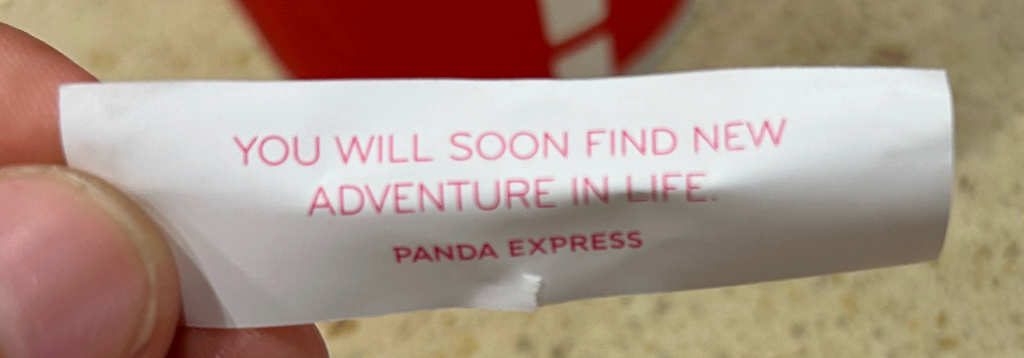
I’ll end with the fortune I received yesterday from Panda Express.

Virtual Worlds as Theme Parks

The more I play World of Warcraft and the more videos I watch on the topic, the more I realize the design of the games and the worlds are no different from the designs of theme parks. I thought about what new games and old are doing to attract players, what players can do while they stay in their world, and what the relationship between the designer and player is like. Funny enough, as soon as I thought of theme parks and MMOs, I remembered I watched a youtube video not too long ago about the design of MMOs as theme parks.

It turns out this video is over a year old now. I didn’t quite think of this video when I began this post, but it certainly captures important elements of online world design. The author describes differences in game design attitudes when shaping the worlds and how players interact with them. Some designers build set experiences like rides in a theme park, some designers build sandboxes in which players choose to create their experiences. There’s a lot more risk and instability when it comes to designing sandbox games. It is that difference which sparks the divide between online worlds being mostly set experiences, as set experiences are easier to design and forecast.

We know set experiences are easier to design because we see them so commonly in the gaming genre. Very few games give players a majority of the tools and let players build the majority of experiences. By nature, creating numerous possibilities takes numerous tools, and the most fun possibilities are the surprising ones, which are difficult to design or manage.

Bringing this idea back to the real world, entertainment in large spaces can be seen as sandboxes or theme parks, and should more heavily lean into their own identities. Music gatherings become music festivals, social gatherings become bars and clubs, etc.

I’m not exactly sure what the closest parallels are, which can be commercialized or organized, for sandbox entertainment. The closest I can currently think of are fairs, markets, or holidays in general. But I do know that theme park rides, cinema, and festivals deeply parallel online experiences we enjoy at home, but in public mass settings.

There are a couple of internet to reality based gatherings, such as anime conventions or gaming tournaments. In these micro-environments, people can hold different identities and status compared to their normal lives. It is this very essence which prompts this post, the essence of further identity and engagement that videos games and virtual worlds accomplish, but few real world events do.

The best real world example of identity and subculture contextualized in an event is a sporting event. Fans of one team sit opposite of fans of the opposing team, cheering for their respective teams on a field. As successful as sporting entertainment is, it is a passive hobby which the user best enjoys live, a tiny timing window in the grand scheme of things. What if there were virtual words or real world places for fans to gather and interact? Well, there are. There are fantasy leagues, there are sports bars, there are stadiums and merchandise. But it still differs drastically from a gaming experience.

Fans can separate themselves from others with knowledge and time investment or with rare or expensive collections. How can that be reflected in reality? When a character in an RPG enters a dungeon, it is similar to a person in a theme park going on a ride. The dungeon never changes, as does the ride. But in RPGs, the character entering the dungeon is different (hopefully) each time. While it is true a man can never step into the same river twice, how can fans see or feel a feedback system which responds to their participation in real life?

It’s easy to think of merchandising options or NFT wallets or some marker to identify our super fan and to grant some kind of exclusive access. This type of thinking is too basic, relying on cosmetics or video game features to override reality. We can point to current examples like court side seats, ticket availability in general, limited whatever. There are numerous ways for our fan to invest into the game, but so far the only feedback I’ve been able to list is seating or merchandise availability. Maybe that is the best feedback a fan can receive. A better view and something to take home.

Dungeons get easier the more geared and experienced a player or the group is. The rewards from the dungeon are static, but the experience becomes smoother, and the joy comes from within. Now, most players stop doing a dungeon once they have received a particular piece of loot they have been looking for, waiting for random chance to go in their favor. Still, the fun of the dungeon comes from a sense of progress internally, as the player builds themselves up against a set experience.

Is there a theme park or an environment, where shared-world users can slowly increase their agency and status, independent of the real world? Am I just describing high school?

Tracing Outlines and Finding Character

In the beginning of 2022, I read a delightful book by one of my favorite authors, Malcolm Gladwell. The book was Talking to Strangers and details all the conceptions and misconceptions we have when communicating with others. I do need to revisit this book again, because this blog post isn’t necessarily about this book, but rather what I’ve come to find is true when speaking with others and becoming close with them.

I have an extremely varied history of hanging out with people of all walks of life. I’ve made friends with people in all sorts of settings, from hospital wards to hotel conventions, and homeless shelters to millionaire residences. An intriguing thing about meeting so many people is what it is like to become close to them and what our initial impressions of them inform us about them. Was that thing I noticed at first a red flag? Or was I just being far too judgmental?

A friend once told me, “What you see in the first ten seconds of meeting someone typically tells you all you need to know.” I was shocked by their statement and asked if they really meant it. “Yeah, what they say, how they act…”

I’ve heard more than one great quote about first impressions.

“You never get a second chance to make a first impression.” -Will Rogers

“Two things remain irretrievable: time and a first impression.” -Cynthia Ozick

“You only have one first chance to make one first impression that lasts a lifetime.” -Nas

But to what merit do first impressions really hold? Don’t people typically move with their best foot forward? Do we not live in a digital age in which any manner of thing can be manipulated, highlighted, omitted, etc.? I certainly wouldn’t base my entire outlook on another person simply from their handshake. But as humans it really is impossible for us to not to judge or catalog in any sort of manner. Some may do it less than others and not all perceptions are enacted as judgments. The real question is: which things can we see in others that remain true over time? What are true red flags? What are true green flags?

There are dozens of personality tests online and several axis in which I could measure personality and actions. Some may ascribe to astrology or typing to describe actions and follow through. Others use personal experience and sands in the line to determine who they think they are dealing with. Here are some things that I believe traverse culture, gender, religion, and identity.

  • How does this person see themselves in relationship with the world?

This relationship typically changes very slowly over time. When you meet someone, there is relative certainty your snapshot of their relationship with the world is accurate unless there is drastic change, change that is probably easy to document or observe. What do I mean by relationship with the world? Well it extends into many things. How does this person handle responsibility? Are all things one on person’s shoulders? Whose? Are things equally divided? Under what circumstance? It’s easy to see this getting quite political, but I’d argue these ideas inform us of a person’s politics rather than the other way around. This question can also get quite abstract and what I found most helpful was to see people with similar positions handle different situations and people with different positions handle similar situations. Isolating situation vs position can help us determine personality.

  • How does this person interact with others?

This questions get very tricky, very quickly because of the way to interpret this question. Typically we ask ourselves this question, with ourselves as the object. How does this person interact with me? And, it is just as easy to observe someone interact with another and confuse this interaction or misjudge them. Typically, people are quite conscious of their actions when they are interacting with someone they feel is important. The less important or serious someone thinks of the situation, the less conscious they are. This is how we get stories of people observing how others treat service staff but this is also how we get social media videos of gift giving to the homeless. It’s important to note with this question and with all other questions that this blog post is about getting to know people over time, and with that comes multiple observation points. It is extremely easy to judge or misjudge someone off of one interaction, such as getting cut off in traffic or someone passing on the last slice. Look for interactions that seem genuine or personal and see in which situations does this person act differently.

  • How does this person respond to change?

“Change is the only constant in life” -Heraclitus

Our response to change and our observation in others informs us about how we feel about our current situation and our ability to navigate life. Simply put, those who dislike change are those we feel most comfortable in the current situation and do not wish to navigate to any other situation. It’s easy to hand-wave off those who dislike change with the previous sentence, so we have to remember change is often extremely difficult for anyone to handle. Despite that, change is persistently occurring, so it is an important quality to observe in others. This question colloquially comes out as, “Oh he’s just a pessimist,” or “Wow, you’re such an optimist.” Yet the question of how people handle change can vary dramatically from subject to subject. An extremely open minded person could be a stickler for plain foods. I find this question informs me of what values are immutable and which situations are inconsequential, and that can tell you a lot about someone.

  • How has this person changed in the last year?

We do ourselves injustices by judging others off of snapshots. These judgments exist because they work in some fashion, some where and in some time, they have helped us avoid working with or dealing with bad situations. We call these red flags. We’ve heard of people counting red flags and either having them whiz by an oblivious person or enacted on and ended by a firm believer. But what I rarely hear is the nuance and the change in judgments about someone. Typically this is because walking back an opinion is not only unsexy, it’s hardly worth sharing. Most opinions people share are face-value, instant reactions, in the heat of the moment, when the conversation was current. Unless people see a strong consequence or result by publicly changing an opinion, there rarely is public display of change of opinion. So to that I say, withhold an opinion if possible until you find it difficult to change your opinion. Easier said than done, as most people have a hard time understanding to what degree they could change their mind on something. But none look more foolish than those who jump from bandwagon to bandwagon with such little conviction of their own. Instead, hold an opinion of someone and have charitable interpretations, opportunities for change, and remove eggshells/landmines in their path before you close the door on your opinion of them. It is highly likely you or I have made a bad impression or snapshot, but quickly made up for it moments or situations later. With all that said, two is a coincidence and three is a pattern, so unless the person is oblivious, it is a conscious behavior and pattern.

These four questions encapsulate all I have to ask about someone after knowing them month after month, from knowing hundreds of acquaintances to making just a few dozen close connections. They are not as punchline or sexy as “Does this person talk behind other’s backs?” or “Is this person a hypocrite criticizing others but not themselves?” Witty and petty remarks can all fall back into these questions.

Remember that all time and effort is finite, so we can understand a lot about someone based on how they spend their time and effort. Spend your time and effort effectively by figuring out what’s important to you and sticking to a positive and constructive mindset. Meet others and find those whose characters match yours. Be the change you wish to see. Answer the questions above with yourself in mind.