Lift Up

Speaking highly of others when they are not in the room is a simple yet impactful habit. Do you remember the last time you spoke positively about someone when they weren’t around? Perhaps you praised a colleague’s hard work during a team meeting, commended a friend’s kindness to others, or acknowledged your partner’s thoughtfulness to a mutual friend. If you have, congratulations! You have developed a great habit that can transform your relationships and elevate your own character. Here are some compelling reasons why this habit is worth cultivating:

  1. Fosters a Positive and Supportive Culture: When you speak positively about someone behind their back, you create a culture of respect, encouragement, and support. Your words can influence the way others perceive and talk about that person as well. It promotes a sense of unity, cooperation, and camaraderie, which can boost morale, productivity, and overall well-being in any setting, whether it’s the workplace, home, or social circles.
  2. Builds Trust and Credibility: Speaking highly of others demonstrates your integrity and sincerity. It shows that you are not only willing to acknowledge others’ strengths and achievements but also genuinely appreciate and celebrate them. This builds trust and credibility among your peers, as they see you as someone who is fair, reliable, and uplifting. Trust is the foundation of any healthy relationship, and speaking highly of others can help you earn and maintain it.
  3. Encourages Growth and Development: When you speak highly of someone, you are not only recognizing their current abilities but also encouraging them to continue their growth and development. Your words can motivate and inspire others to strive for excellence, take on new challenges, and reach their full potential. It can also boost their self-esteem and confidence, leading to improved performance and a positive mindset.
  4. Reflects Positively on Your Character: The way you speak about others says a lot about your own character. Speaking positively about someone when they are not around reflects your kindness, empathy, and maturity. It shows that you are secure in yourself and confident enough to celebrate others’ successes without feeling threatened or jealous. It also indicates that you have a positive mindset and choose to focus on the good in others, which can be an attractive quality that draws people towards you.
  5. Enhances Your Communication Skills: Speaking highly of others requires effective communication skills. It involves choosing your words carefully, being mindful of your tone, and expressing yourself with sincerity and authenticity. This habit can sharpen your communication skills and help you become a better listener, observer, and speaker. It also encourages you to be more mindful of the impact of your words on others, promoting positive and constructive interactions in all areas of your life.

Speaking highly of others when they are not in the room is a remarkable habit that can bring about positive change in your relationships, character, and communication skills. It fosters a culture of respect and support, builds trust and credibility, encourages growth and development, reflects positively on your character, and enhances your communication skills. So, let’s cultivate this habit and create a world where uplifting others is a norm, both in their presence and absence.

Great minds discuss ideas; average minds discuss events; small minds discuss people.

Eleanor Roosevelt

Be the one who discusses ideas and speaks highly of others!

Persisting Through Doubt

Doubt is a natural part of life, and it’s something that we all experience at some point. Whether we’re trying to achieve a goal, pursue a dream, or simply make a decision, doubt can creep in and make us question ourselves. But the key to success is not avoiding doubt, but rather persisting through it. In this blog post, we’ll explore some tips and strategies for how to do just that.

  1. Identify the source of your doubt

The first step in persisting through doubt is to identify the source of your doubts. Is it a lack of confidence in your abilities? Fear of failure? Comparison to others? Once you know where your doubts are coming from, you can start to address them directly.

  1. Reframe your doubts as questions

Instead of seeing doubt as a negative, try reframing it as a question. For example, instead of thinking “I’ll never be able to do this,” try asking “What do I need to do to achieve this?” This shift in perspective can help you approach your doubts as opportunities for growth rather than obstacles to overcome.

  1. Focus on your progress

When we’re in the midst of doubt, it’s easy to get caught up in what we haven’t accomplished yet. But instead of focusing on what you haven’t done, focus on what you have accomplished. Take some time to reflect on your progress so far, and use that as motivation to keep pushing forward.

  1. Lean on your support system

When we’re feeling doubtful, it can be helpful to lean on the people around us for support. Reach out to a trusted friend, family member, or mentor and talk about your doubts. They may be able to offer encouragement, advice, or simply a listening ear.

  1. Embrace failure as part of the process

Failure is a natural part of any journey, and it’s something that we all experience at some point. Instead of seeing failure as a sign of weakness or inadequacy, try reframing it as a necessary step on the path to success. Embrace failure as an opportunity to learn, grow, and improve.

  1. Keep moving forward

Perhaps the most important tip for persisting through doubt is simply to keep moving forward. Doubts may arise, but don’t let them derail your progress. Focus on taking small steps each day, and trust that over time, those steps will add up to something significant.

In conclusion, doubt is a natural part of any journey, but it doesn’t have to hold you back. By identifying the source of your doubts, reframing them as questions, focusing on your progress, leaning on your support system, embracing failure, and keeping moving forward, you can persist through doubt and achieve your goals.

Holding Onto Poison

Holding onto anger is like drinking poison and expecting the other person to die.

Falsely Quoted as the Buddha

I had not known this quote was falsely contributed to Buddha until I had Google’d it.

Fake or not, I find the saying to be true. It does very little to the other person to hold resentment. Some take their resentment further, finding ways to manifest it and to attack their villain. Whatever the outcome, whatever the result, whatever route anyone takes, resentment requires a source.

The second law of thermodynamics:

“…heat always moves from hotter objects to colder objects (or “downhill”)…”

This law of thermodynamics introduces entropy, a constant force at play causing a reduction in energy over time, over steps. It also implies that energy cannot go backwards without something supplying energy to reverse the flow. Meaning once something starts off as something, it cannot reverse naturally.

What does this mean for anger?

Sending out anger out into the world bears very little fruit, as every moment and every step away from its source reduces the power of the anger. The recipient will never receive the same amount of energy as the sender originally had. Additionally, the little fruit anger bears will be fruits of anger, as the only way there could be any other yield would require an equal and opposite force.

Anger, and negative emotion in general, is difficult to wield. We must be careful not to cultivate it actively or passively, as it will grow and become more difficult to manage.

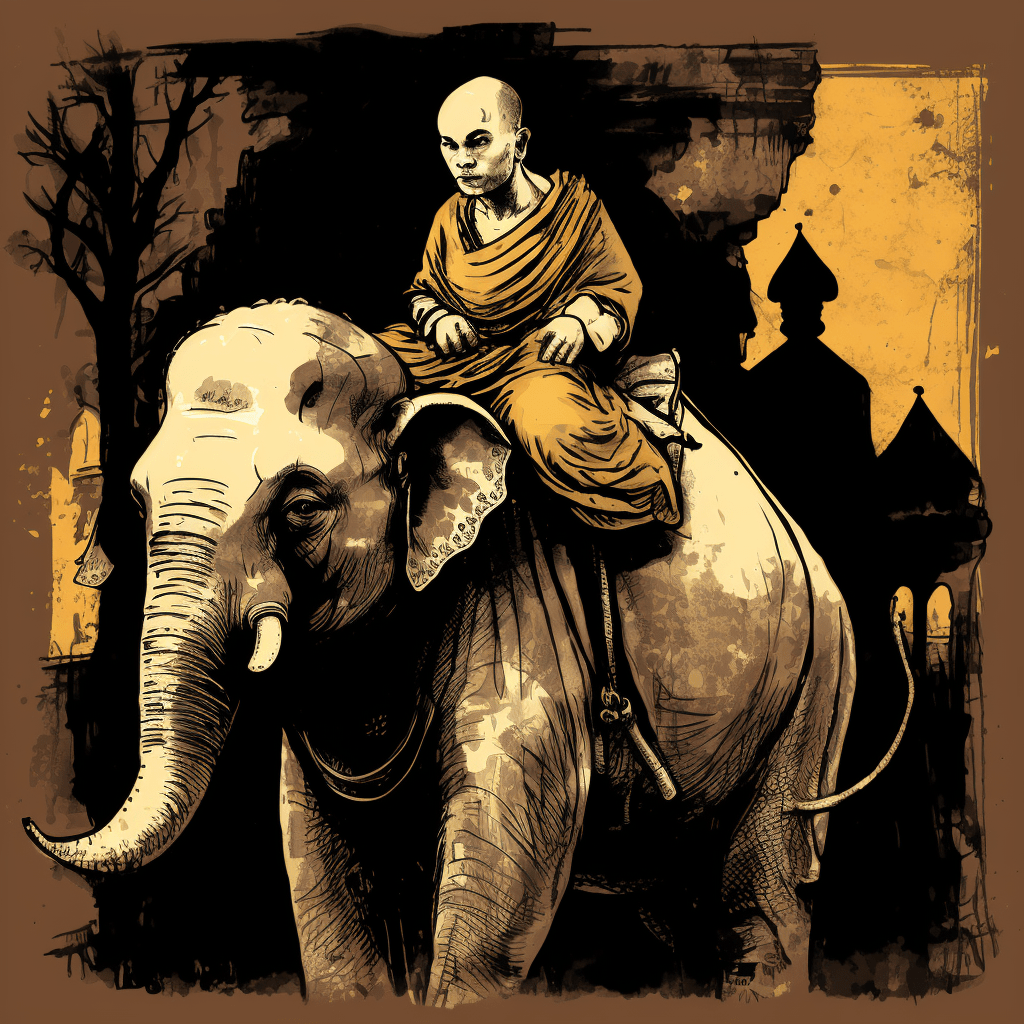
A famous analogy in psychology popularized by Jonathan Haidt describes us in two halves, a rational rider and an emotional elephant.

The rider represents the rational thinker, the analytical planner, the evidence-based decision-maker. The elephant, on the other hand, is an emotional player, full of energy, sympathy and loyalty, who stays put, backs away, or rears up based on feelings and instincts. The elephant is often on automatic pilot. 

How we navigate the world atop of our emotional elephant tells us what we think of our own emotions and their role in our decision making as well as the temperance and attitude of the rider mastering their emotions. There are lots of different views on the topic of emotion, varying from always listening to them to stoically holding back all feelings. Like many things in life, there is no one right answer. A common answer a friend can share with you, on the relationship between a rider and its elephant, is that the rider should decide where the two go in life, no matter how the elephant feels. Feelings can change and feelings are not the best predictors of new lands, which is why knowledge and experience are used to navigate the unknown.

We need not be cruel or uncaring to our emotions in totality, but the reverse is death of the rider. Without any emotional control, the rider is no longer in control of their destiny; the rider is at mercy to their emotions. This makes very little difference in times of peace. When times of war strike, chaos shall ensue and the rider must do his best to weather the storm. I pray that we all see sunny days, and on the few rainy ones we are prepared and optimistic. Hold on steady to your emotions and decide between the two of you who is in charge.

Think in Prosperity

It’s easy to catch yourself in a rut or to experience a rainy day or two. There’s steps to take beforehand to make these times easier on ourselves. There’s also steps to take in those moments to let optimism and prosperity in.

Think big. Bigger and better.

This relates to our environment. For many people, it’s not easy to change their environment or their headspace. It’s much easier to become complacent or comfortable in a familiar surrounding.

But did you know it’s easier to change your environment than it is to change your habits?

Some people are shocked when they hear this, while others connect with it very quickly. Ever gone on a diet and removed all of those foods from your home? You have to leave the house to cheat on your diet! Ever put yourself in a library to get some peace and quiet and to focus? Have you ever turned off your phone or deleted an app?

Environments and headspaces inform us of the likely outcomes ahead of us. We can have the best attitudes and intentions, but our limited choices may lead us to the same result over and over.

So why do I keep equating environments and headspaces? It’s certainly possible to purely change one’s environment, placing themselves in better locations with better friends. But it’s also much more easily possible to change the landscape within your own mind. People do this by reading books or listening to self help tapes. People do this with the free time they have, watching television or playing video games. A powerful saying is:

A man is what he thinks about all day long.

Ralph Waldo Emerson

No matter what the activity or the setting is, the space our mind is in plays a part in how we navigate the world. Similar to attitude, similar to environment, shaping our mind allows us to reach beyond what is simply around us or before us. With creativity and entrepreneurship, something must appear from essentially nothing. So with every endeavor, we have the choice to simply make what is around us or the choice to make what we can imagine. So, think in prosperity. Imagine bigger. Because I cannot see a bright future in which we do not choose to do this. How can there be a best version of the world if we don’t imagine and believe in one? It’s not to say we shouldn’t prepare for the worst, as this post began. But it is to say that what we make is a combination of what is around us and what we believe in. So believe in the best. Believe in yourself.

No Homers Club

Homer the Great is S6E12 of the Simpsons. It has an iconic scene in which Homer recalls a childhood memory where he is turned down entry into a treehouse. A gatekeeper eagerly accepts everyone except for Homer. When asked why, he points to a “No Homers Club” sign. In perfect comedic timing, Homer rebuts that they allowed another Homer into the treehouse. Without missing a beat, the gatekeeper says, “It says ‘No Homerssssssss. We’re allowed to have one.'”

This scene is incredibly funny because Homer sets up this story as everyone hates him and the world is against him. I think we’ve all felt that same anxiety and fear before. The extreme specificity of the example is so humorous, especially with the inclusion of an exception. I think we’ve all felt unfairly treated at one point or another in our lives and have looked at others in similar positions to only find different outcomes. It’s not easy explaining to people that life is not fair, especially if they perceive it to be unjustly or overtly unfair to themselves.

There are certainly times when life truly is unfair. But what can really be done about it? People like to believe the grass is greener on the other side, but most often the case is that everything has its pros and cons. We can seek different environments or different friends, but problems tend to follow us if we don’t resolve them. We can make changes to the things around us and we can make changes to ourselves.

It’s funny because we say the only thing we can count on is change, but there’s some things that never change. The episode Homer the Great is not only iconic with its infamous meme, but also because it ends the same way Homer recounts his childhood, with another No Homers Club created in his dishonor. The storytelling and humor are so fantastic because they relate to the human experience and because we find ourselves in the same problems we had as a child, with almost cartoonish exaggeration.

While it’s certainly possible the world is out to get you and an existential crisis can be so overwhelming, what we can do is control ourselves and our decisions, which plays out into controlling and creating our future. Don’t let patterns of the past define your future and don’t let the perceived antagonists stop you from changing yourself and your future.

Hedgehog Dilemma

Neon Genesis Evangelion does a great episode on the concept of The Hedgehog’s Dilemma, a phenomenon in which bristle-backed creatures are unable cuddle for warmth without hurting each other in the process.

This concept terrified me as a teenager, who lacked opportunities for intimacy and partner building. In many aspects of my own life, I’ve found myself to be destructive to not only myself unintentionally, but also towards those close to me. It’s a very difficult thing to swallow, as the results of absence are easier to detect than the faults of intimacy. With each practicing moment of engagement comes another opportunity for failure.

This dilemma subsided to the backburner of my mind in my college years. Teenage me was much more hormonally conflicted, less experienced, and more lonely. Despite this neuroticism subsiding, my social life did not pick up dramatically. In fact, it was rather the opposite, in which the neuroticism that protected my brash and socially unaware self became less of an armor and more of a cloak of hiding.

The only thing that brought me out of hiding was my purpose, or my dharma. I would ignore all of my fears and intuitions about social interaction and I would charge forward with discrete action in mind. A lot of this charging was coupled with logical research and experience, of understanding and navigating social situations, but it was still overconfidently charged nonetheless.

In a much broader topic I’ll discuss in the future, my ability to connect with others was linked with me finding my adult male identity, coming of age from an adolescent teenage male with very little status or accomplishment. It took a lot of external circumstance and experience for me to not only be comfortable around others, but to have them take a likewise interest in me. A misconception I had about the hedgehog’s dilemma is that human personality is not malleable to circumstance and that physical arbitrators stand in place of emotional or personal desires. Humans are capable of relaxing their quills and of connecting with others, despite what our social anxiety and neuroticism tells us.

Reach Two Hands Down

I used to live in Chicago for over 10 years. I moved to California because I was offered free housing by the esports organization I was working for at the time. The owner, Reynad, was a prolific gamer and was working on his own game. He invited me over for lunch to chat about his game and to see if I could provide any valuable input to his creative process. As we walked into Huntington Beach, I confessed to him how influential he was to me, as he inspired me to create my own organization in Chicago. He naturally replied to something of the effect, “No need to thank me. I know that you’ll inspire others and that it’ll continue to pay itself forward.” He admitted he began esports because of organizations bigger than him and that we were all small parts of a larger journey.

I find myself spreading this message quite naturally, as I’ve seen a part of myself in every community organizer I’ve met. The identity and journey is so relatable to me, that it is only natural for me to inspire, engage, and learn from others and to wish they do the same further on.

My casual guild has around 800 members, but very few of them are active or responsible members, making a smaller more tight knit guild much more engaging in some ways. Whenever I get asked how can we handle more responsibilities or what we should be focusing on, I always spread the message of reaching down and pulling up. The more members and the more responsibilities are present, the more imperative it is to not place responsibility on ourselves, but to enable and strengthen others so that the entire group can endure and persevere through challenges.

I have been led by leaders who led in the front and led by leaders who led from the back. An unspoken yet respected rule is that we are eager to lead each other side by side. It is just extremely rare for egos, agendas, and ambitions to all line up. It is why it is so easy to become rivals rather than peers, it is difficult to look at an open hand with humility and it is difficult to extend an open hand with humbleness. Find those who do either and eventually you will do the same.

Unbridled Confidence

Unable to sleep, I logged into World of Warcraft to sneak in some productive gameplay. I cleaned out the guild bank and discord while waiting on my dungeon group to fill. It took quite some time, as I crossed off a bunch of errands off of my list before the group disbanded and I had to form my own group. Typical late night struggles.

An hour into my dungeon wait, the group finally filled and we were set to start the dungeon. “123” a mage typed. I opened my map; no one was even close to the dungeon. This mage saw the group fill and typed 123 immediately. What a guy. He asked for a summon before anyone was there to do one. “Be considerate.” I replied. He checked his map and confirmed.

No one close to the dungeon and no movement on the map. I guess I’ll find a way to make it to the dungeon. To be able to fly in the continent of Northrend, one must learn Cold Weather Flying, a tome which is tradeable from character to character. I swapped over to my Alliance server and sent this tome over, one of the very few things I can trade between servers and factions. I logged back over and taught my character how to fly. I rose to the sky and pointed myself south by southwest, out of the city and onto the dungeon.

I opened my map and there has been little movement. Except, wait. Our mage has moved. I hovered over his character portrait and checked his buffs. His movement on the map seemed… indirect. As if he was following paths across the land. Sure enough, in his buff list, was a Hawkstrider, a swift ground mount. This mage had ridden across the land and met me at the dungeon’s entrance within seconds of my arrival. Without a word, we began summoning the rest of the team.

A pleasant surprise, this mage. We grabbed our quests and zoned in.

A message appears in guild chat. “when did wow add a playlist”

I replied, “what”

My guildmate went on to describe how there’s weird metal music playing in Terokkar Forest. “when did they add music?”

I’m confused. I tell them there’s always been music.

“no, there hasn’t. i haven’t played in a while but i’ve never heard it until now.”

There are a lot of new players in my casual guild. I explain to him the default keybinds to turning music on and off. I tell him that the game has had music since its initial launch. He pushes back.

“it’s never had music”

I tell him we can simply google it and another guildmate agrees with me. I ask him, “Did you really think the most popular game in the world at one point didn’t have music?” He quickly replied yes.

I didn’t quite know what to say at this point so I told him, “Wait til you get to Northrend, your mind will be blown.” The music director for this expansion was incredible, so his mind will indeed be blown.

The dungeon went on smoothly and guild chat remained silent. His conversation stuck with me until the end of the dungeon. Our tank had never ran the dungeon before and needed a little guidance. While he charged forward rather confidently into what was a mystery for him, our tank took feedback well and the run was very smooth. I shortly after went to bed.

Is confidence a horse-blinder? Allowing us to charge forward? Do we let our experiences and our confidence blind ourselves to reality? Inversely, we cannot be so skeptical and fraught that action can never be taken. Perhaps the availability of information and the veneer of social media encourages us to be bold and brazen first, subtle and skeptical last. I’ll cover generational conversation more in a future post.

Spirit of the Escalator

A term coined in French, L’esprit de l’escalier, is afterwit, or the witty remarks thought of after having descended stairs. The Wikipedia article does a great job of detailing the origin of the story, including a reference to “the bottom of the stairs” which indicates a guest has fully left a gathering.

Witty or remarkable, our ability to reflect upon things allows us to speak greater on that topic. It is why skilled conversationalists carry conversations with their charisma, because conversations are rhythmic and the best don’t drop a beat.

Typically writers experience this phenomenon the most, as collecting and organizing thoughts can become an instrumental task to their expression. I’ve sometimes thought of this as introversion and the extraversion, but charisma comes to both spectrums. The life of the party may not be the speaker of the party and the person least engaged may have the most to say.

The term Spirit of the Escalator resonates with us because we have been in dialogues where we couldn’t properly reply and we thought of a reply afterwards. We appreciate its French origin because we like to think of ourselves as witty and cunning. The spirit captures but one element of conversational reflection, that element being comeback.

As our conversations take shorter and shorter forms, the desire for sharper and snappier comebacks increases. With more accessible conversations that have become narrower in digital spaces, from lack of intonation to lack of context, we have allowed conversation to boil down to bullet points and sound bites, thereby increasing the need for comebacks. Nuanced conversation, with give and take, becomes less attractive to traditional broadcasts day by day.

Now there is an equilibrium, where an opposite and equal reaction manifests at a critical point. When our distaste for short form content becomes too great, we gravitate towards long form content. Of course, these long form content creators will produce smaller pieces of their own content, indicating a self-awareness and sense of ownership towards sub-content. But the major draw of long form content is the ability to reintroduce long conversation, without the conversation turning into a martial art of offense and defense, of maneuvering around sound bites.

The term Spirit of the Escalator carries a modern invention’s name in it. Sure, I could be taking the translation too literally, with any set of stairs mechanical or not considered to be “l’escalier.” I wonder if the term’s genesis comes from a different age of conversation. When conversation was once communal, it now has became guarded in ivory towers with both speakers and audience on the defensive. It is remarkable the internet has recreated these ivory towers in some ways, in the form of closed communities and echo chambers, while the internet has also opened doors by removing gatekeeping and allowing different forms of conversation to be tested in the market.

It will be truly interesting to see what terms we’ll be using to describe texting or leaving a zoom call. Hell, we can’t even slam phones anymore. Our technology shapes our responses and sometimes the responses we’ve learned become phased out entirely. What will be our next Spirit of the Escalator?

Proximity and Relations

After the height of the pandemic, I was in need of a part time job so I went out around my town and looked for one. I applied to a few places but the place that accepted me immediately was Jimmy Johns, a sandwich franchise I had once worked for in college.

As usual with minimum wage jobs, there were a handful of teenage coworkers. Teenagers have changed slowly over time, revealing how old I really am. While some things changed and others hadn’t, I would gather little nuggets of information from my coworkers, learning more of the status of the high school, its local community, and what the students were like.

From stories of kids vaping in school, to having sex on campus, social media and flagrant attitudes have embolden students to take their teenage life into their own hands, rather than be subjects of high school. When once high school was an academic time-out to let hormone imbalances naturally settle, it has now become a playpen of agency for high schoolers to compliment and criticize their peers online.

While the topic of social media both dividing us and connecting us with more opportunities is a nuanced and complex topic, the topic of today’s post is actually about the absence of proximity during the pandemic and how it affected high schoolers.

Despite it being early for academic backed papers to come out and address how the pandemic has affected education on an academic level, kids are already describing how the pandemic has affected education on a social level.

The most succinct explanation I got was “they just don’t know how to talk” or “they haven’t really matured” when asking about freshmen and sophomores. The high schoolers explanation was that usually middle school students have a coming of age or maturation in their first two years of high school, developing social skills and and understanding their social environment. That went out the window the two years students were learning from home, in isolation, away from their peers.

I could argue that with or without the pandemic, our younger generation has become more in tune with their phone world than with our shared world, which has several implications on its own, including the inability to communicate with generations that lacked this technology. My previous post, Digital Integration and the Chinese Room, covers how technology and social media have changed our communication.

Social media and our digital evolution is only a part of the equation in why the teenage social atmosphere is the way it is. The other half will be largely influenced by an absence of proximity, caused by large issues like the pandemic ranging to small issues like service on demand.

I’d like to touch on the topic of dating in the digital age as well as further touch on the topic of disconnected communities, within education and other sectors. For now, I’d like to leave off with a question. Technology has created new avenues for old needs, allowing us to do age-old activities in new ways. What are some ways technology could help us do new activities, in age-old ways?