Advice and Context

Advice and information are essential components of decision-making, problem-solving, and personal growth. However, they can be of limited use when one lacks context or experience. In this post, we will explore why advice and information become most practical once there is context and experience.

Context is critical because it helps us understand the circumstances surrounding a situation, event, or decision. Without context, we lack the necessary background information to make informed decisions. For example, if someone gives us advice on how to negotiate a salary increase, it may not be practical if we do not have the context of the industry standards, company culture, and performance metrics. However, if we have a clear understanding of the context, the advice becomes more applicable and useful.

Experience is also essential because it helps us understand the practical implications of advice and information. Experience enables us to recognize patterns, anticipate outcomes, and adjust our approach accordingly. For example, if we receive advice on how to manage a difficult employee, it may not be practical if we lack the experience of handling similar situations. However, if we have experience, we can draw upon our past successes and failures to apply the advice more effectively.

Furthermore, experience allows us to personalize advice and information to our unique situation. No two situations are identical, and advice that works in one context may not be practical in another. However, with experience and wisdom, we can adapt and tailor advice to fit our specific circumstances.

In conclusion, advice and information are valuable resources, but they become most practical when there is context and experience. Context helps us understand the circumstances surrounding a situation, while experience allows us to understand the practical implications of advice and information. By combining context and experience, we can make informed decisions, solve problems, and grow personally and professionally. So, the next time you receive advice or information, take a moment to consider the context and draw upon your experience to apply it more effectively.

Presenting a United Front

In any group or organization, whether it be a family, a team, a company, or even a World of Warcraft guild, presenting a united front is key to success. When everyone is on the same page and working towards the same goal, it’s much easier to achieve success and overcome challenges. In this post, we’ll discuss why presenting a united front is so important, and offer some tips for achieving it.

First and foremost, presenting a united front builds trust and credibility. When everyone is working towards the same goal, and communicating clearly and honestly, it builds trust between team members, and with external stakeholders as well. When people see that everyone is on the same page, they’re more likely to believe in the group’s mission and vision, and more likely to support them.

In addition to building trust, presenting a united front also helps to avoid confusion and miscommunication. When everyone is working together and communicating effectively, it’s much less likely that messages will get lost or misunderstood. This can be especially important in high-stakes or sensitive situations, where miscommunication can lead to disastrous or escalating consequences.

Furthermore, presenting a united front helps to build a sense of community and camaraderie. When everyone is working towards a common goal, it fosters a sense of belonging and pride in the group. This can lead to increased motivation and commitment, as people feel like they’re part of something bigger than themselves.

So, how can you achieve a united front in your own group or organization? Here are a few tips:

  • Define your goals and mission: Make sure everyone is clear on what you’re trying to achieve, and what your values and mission are.
  • Communicate regularly and openly: Encourage everyone to communicate openly and honestly, and make sure everyone is kept up-to-date on progress and challenges.
  • Address conflicts head-on: If there are disagreements or conflicts, address them openly and honestly, and work together to find a resolution.
  • Lead by example: Leaders should model the behavior they want to see in others, and set the tone for the group.
  • Celebrate successes together: When you achieve a goal or overcome a challenge, make sure everyone is recognized for their contributions, and celebrate together as a team.

In conclusion, presenting a united front is crucial for any group or organization that wants to achieve success. It builds trust, avoids confusion and miscommunication, fosters community and camaraderie, and more. By defining your goals and mission, communicating openly, addressing conflicts head-on, leading by example, and celebrating successes together, you can create a united front that will lead to success and fulfillment for everyone involved.

Inspiring Attendance

I’ve been leading a lot of raids in World of Warcraft, what else is new?

When I first started playing this expansion, I was in a much smaller, more serious guild. We were able to kill the content quickly and people were very competent. We weren’t the best of the best, but we were improving steadily. Before Ulduar came out, it almost seemed too easy. We weren’t the only ones who experienced this, I saw many players quit the game as soon as they got their achievements.

Logging in to the game to find players leaving, communities becoming smaller, is not a good feeling. There were times where I felt alone when I logged in, especially when playing an Alliance character, away from my Horde counterparts I had invested in years before. Raid nights were different and attendance would jump up to nearly a full raid. The numbers began to dwindle and I lost focus on that server, preferring to return to my old Horde characters.

On my Horde server, I’ve found an amazing community of casual gamers. The guild is so large that one players absence is not as detrimental. It’s nice befriending people and checking in on them when they’re unable to play, but it’s not so fun to try to replace these people and have them feel like they’re obligated to join. It’s a nice feeling being able to support an open raiding system with players freely coming in or out based on their schedule, with more serious players coming each week and more casual ones dipping their toes in and out of the water.

For many casual players, this is their first raiding experience or at least first in a long time. It’s a bit jarring for new players to work together in groups of 10 or 25 in real time, but once expectations are understood and the environment becomes more settled in, new players find themselves enjoying it just as much as veterans.

The most rewarding experience in these casual raids is not the RPG elements of the game, as killing the bosses could be done with a much more serious group and loot could be much more seriously focused on. The most rewarding experience is the MMO aspect, logging into a large guild and forming a large group with only guild members, working on content together, and most of all, coming together after the raid to chat about a bright future. I’ve began hosting optional town hall meetings after raids and almost all of the raiders stick around to chat and listen, only a few must sign off early. It inspires me to do a better job of leading the players in raid and a better job organizing the guild in general. Seeing everyone’s willingness to stay, improve, and socialize is truly beautiful.

A Business is Not a Public Service

From a Guardian article written over 8 years ago:

a public service and a business are inherently different beasts and asking one to behave as the other is like asking a fish to ride a bicycle.

The base reason is quite simple. Business survive on cash; money is their bloodline. Public service’s survive based on the people’s will; the governments or communities sponsor public services.

By nature, businesses have to attract more profits; failing to do so means the business dies. By nature, services have to please most members; losing majority popularity means the service loses funding, the only thing supporting it.

While it’s easy to blur the line between the two and believe that servicing the community is part of the business or that doing business is just a part of doing public service, they should not be mixed so easily.

Businesses are hierarchical, not democratic, and wages, terms and conditions are set by the executive and subject to the market.

Although there is some form of hierarchy in all forms of organization, businesses intentionally partition decision making away from portions of the business in order to meet market demands and unequal distribution of responsibilities and reward. This translates to the leader making the most decisions and being rewarded the most while the actors who hold the least responsibility get rewarded the least. Contrast this to public service where the entire organization is beholden to the wants of a community, leading a majority of the decision making, creativity, and responsibilities away from an executive branch to more of a community bulletin board.

When everyone is more similar than dissimilar and the incentive is pleasure not profit, why you’ve created a small communist society. But don’t take that word so negatively in its connotation. In many small groups, communism is a very preferred method of governing. For instance, within a small family or a house full of roommates, treating everyone as equal despite their output can be a very rewarding experience, full of love and understanding. This is not dissimilar from a service, whose goals are never to profit outside of its vision but rather to sustain and maintain what it was set out to do.

Contrast this with businesses, which also benefit from focus, sustenance, and maintenance, but also are willing to make decisions outside of its original vision in order to sustain profits, growth, and the company’s life. While the will of the people make a public service live, a business cannot survive on appreciation alone. Businesses, for the most part, live in a capitalist world in which the market decides what survives and what dies. So not only should businesses strive for more, in terms of profits and growth, they must always strive just to survive, because there is no base of taxpayer money or community goodwill (for the most part).

If public services are communal or communist and businesses are hierarchical or capitalist, how do we so easily blur the lines between the two?

This is because when operating or experiencing a public service or business, there will always be pros and cons unique to each side. Without realizing everything comes at a cost, people imagine the best of both worlds, particularly just for their personal experience. What many fail to realize is that the best of all things comes at a major cost, most of the time in the form of impossibility.

I want to make a business that doesn’t turn away anyone! I have a product or sale for EVERYONE.

This attitude alone drives away a lot of clients. Some clients like exclusion, some like to conform. Not every restaurant can be the Cheesecake Factory and support a menu of 500 items; most restaurants end up going out of business from a lack of focus or finances. The expensive places cannot cater to the lower income population and the affordable places cannot cater to the high income populations. From income, to background, to culture, to belief, there’s always a reason for people to prefer one thing over another.

I want to run our public service like a business! Let’s not settle for zero-sum and let’s grow this operation!

This attitude often upsets governments or communities that began as sponsors of something they wanted to becoming customers of something being held hostage from them. Despite understanding that everything costs something, public services are meant to be inclusive to such a degree in which a normal business may not be able to function, public taxes or community donations are required to keep services alive. Examples include art and music programs, which may not produce an immediate profit but are desired by communities. Other examples include college sponsorships, which are very different from college loans, and waste management services which are very different from junk collectors. Services are meant to be for all, with very little cost or commitment from the benefiters.

There are times in which a business will perform a public service and there are times in which a public service will contract out a business. A difference in philosophy should not stop these two parties from working together, it should actually encourage them to work together and focus on their strengths and weaknesses.

In a future post, I’ll cover how World of Warcraft guilds are actually a business, not a public service.


Holding Onto Poison

Holding onto anger is like drinking poison and expecting the other person to die.

Falsely Quoted as the Buddha

I had not known this quote was falsely contributed to Buddha until I had Google’d it.

Fake or not, I find the saying to be true. It does very little to the other person to hold resentment. Some take their resentment further, finding ways to manifest it and to attack their villain. Whatever the outcome, whatever the result, whatever route anyone takes, resentment requires a source.

The second law of thermodynamics:

“…heat always moves from hotter objects to colder objects (or “downhill”)…”

This law of thermodynamics introduces entropy, a constant force at play causing a reduction in energy over time, over steps. It also implies that energy cannot go backwards without something supplying energy to reverse the flow. Meaning once something starts off as something, it cannot reverse naturally.

What does this mean for anger?

Sending out anger out into the world bears very little fruit, as every moment and every step away from its source reduces the power of the anger. The recipient will never receive the same amount of energy as the sender originally had. Additionally, the little fruit anger bears will be fruits of anger, as the only way there could be any other yield would require an equal and opposite force.

Anger, and negative emotion in general, is difficult to wield. We must be careful not to cultivate it actively or passively, as it will grow and become more difficult to manage.

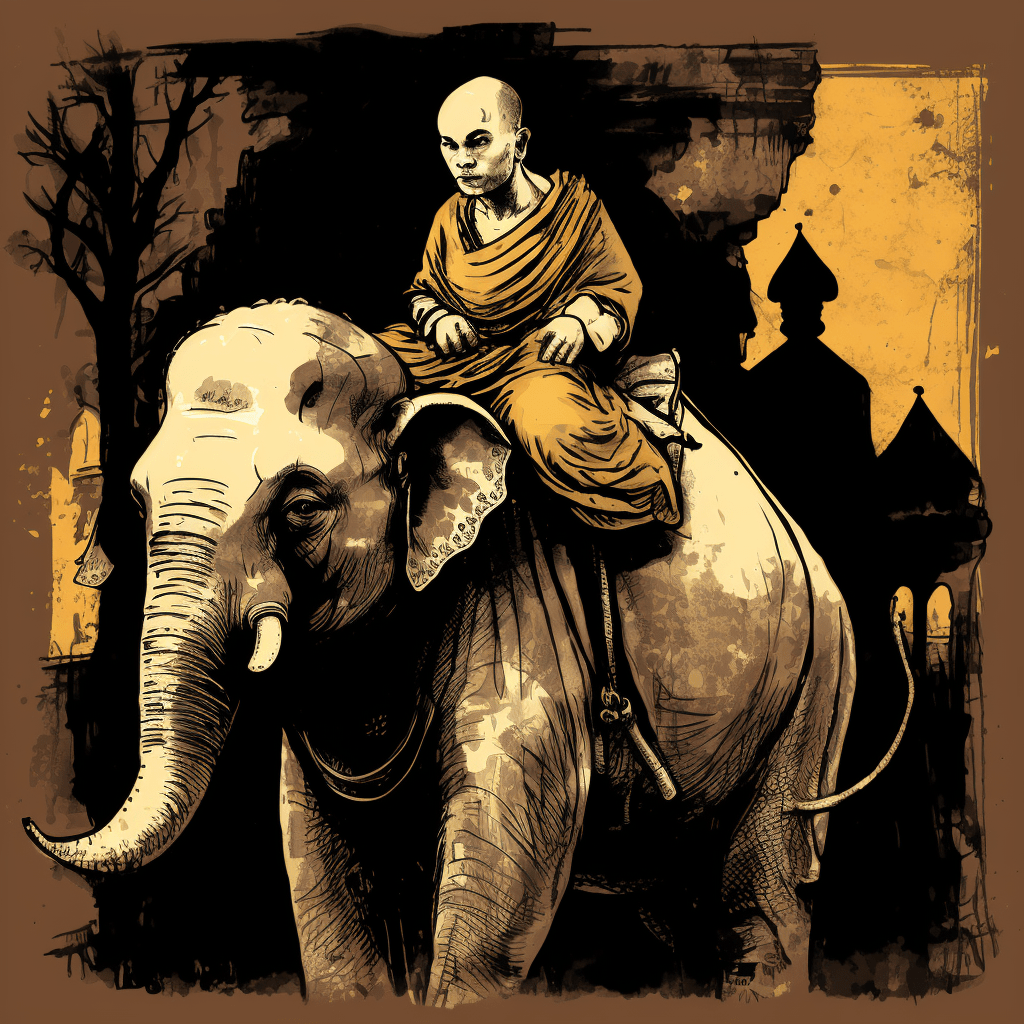
A famous analogy in psychology popularized by Jonathan Haidt describes us in two halves, a rational rider and an emotional elephant.

The rider represents the rational thinker, the analytical planner, the evidence-based decision-maker. The elephant, on the other hand, is an emotional player, full of energy, sympathy and loyalty, who stays put, backs away, or rears up based on feelings and instincts. The elephant is often on automatic pilot. 

How we navigate the world atop of our emotional elephant tells us what we think of our own emotions and their role in our decision making as well as the temperance and attitude of the rider mastering their emotions. There are lots of different views on the topic of emotion, varying from always listening to them to stoically holding back all feelings. Like many things in life, there is no one right answer. A common answer a friend can share with you, on the relationship between a rider and its elephant, is that the rider should decide where the two go in life, no matter how the elephant feels. Feelings can change and feelings are not the best predictors of new lands, which is why knowledge and experience are used to navigate the unknown.

We need not be cruel or uncaring to our emotions in totality, but the reverse is death of the rider. Without any emotional control, the rider is no longer in control of their destiny; the rider is at mercy to their emotions. This makes very little difference in times of peace. When times of war strike, chaos shall ensue and the rider must do his best to weather the storm. I pray that we all see sunny days, and on the few rainy ones we are prepared and optimistic. Hold on steady to your emotions and decide between the two of you who is in charge.

Think in Prosperity

It’s easy to catch yourself in a rut or to experience a rainy day or two. There’s steps to take beforehand to make these times easier on ourselves. There’s also steps to take in those moments to let optimism and prosperity in.

Think big. Bigger and better.

This relates to our environment. For many people, it’s not easy to change their environment or their headspace. It’s much easier to become complacent or comfortable in a familiar surrounding.

But did you know it’s easier to change your environment than it is to change your habits?

Some people are shocked when they hear this, while others connect with it very quickly. Ever gone on a diet and removed all of those foods from your home? You have to leave the house to cheat on your diet! Ever put yourself in a library to get some peace and quiet and to focus? Have you ever turned off your phone or deleted an app?

Environments and headspaces inform us of the likely outcomes ahead of us. We can have the best attitudes and intentions, but our limited choices may lead us to the same result over and over.

So why do I keep equating environments and headspaces? It’s certainly possible to purely change one’s environment, placing themselves in better locations with better friends. But it’s also much more easily possible to change the landscape within your own mind. People do this by reading books or listening to self help tapes. People do this with the free time they have, watching television or playing video games. A powerful saying is:

A man is what he thinks about all day long.

Ralph Waldo Emerson

No matter what the activity or the setting is, the space our mind is in plays a part in how we navigate the world. Similar to attitude, similar to environment, shaping our mind allows us to reach beyond what is simply around us or before us. With creativity and entrepreneurship, something must appear from essentially nothing. So with every endeavor, we have the choice to simply make what is around us or the choice to make what we can imagine. So, think in prosperity. Imagine bigger. Because I cannot see a bright future in which we do not choose to do this. How can there be a best version of the world if we don’t imagine and believe in one? It’s not to say we shouldn’t prepare for the worst, as this post began. But it is to say that what we make is a combination of what is around us and what we believe in. So believe in the best. Believe in yourself.

Maneuvering with Inexperience

Yesterday I hosted Naxxramas 25 for entry level raiders. The content is about four or five months old, in terms of the rerelease. In terms of first release, the content was released in 2008, 15 years ago. I give this game context because players have a large expectation of experience or knowledge when it comes to a rereleased game. I have yet to watch the following video, but it will be a great watch given its view count and production.

While I’ll have to watch the details of this film more closely, the title and the comments suggest that information is readily available to make the experience more playable or more fun, but players choose to ignore this information.

That’s something that’s tough to swallow, especially for the type of gamer who enjoys excelling at their craft. Not every player falls into this category and not all players will follow the same M.O.. The way to solve Rubik’s cubes is posted online, with tutorials and walkthroughs. Does everyone know how to solve one? No, because most people just don’t care for this puzzle.

How is a Rubik’s cube similar to World of Warcraft? With such a large, immersive world, WoW has the ability to engage players with multiple systems and games, not just one front. While a Rubik’s cube’s only enjoyment or fulfillment comes from solving a random or more challenging puzzle, World of Warcraft offers thousands of different puzzles and games, many of which are optional. For some players, the world alone is beautiful enough to engage with.

If anyone can be new or inexperienced at a game, no matter how much information is available, how should we go about our expectations? This is a difficult one especially without communication. I brought up my Naxxramas run from yesterday because it was an arduous and long run. One of the pain points I had was an assumption of knowledge or understanding of communication. There were many times when I relayed boss fights or instructions with open ended assignments or as passing notes. Until I was very specific, with player names and exact positions, did we achieve our best results. This comes at some costs. There are times where I rehearse fights before they happen and there are times when I explain things beforehand and players fail to manage what I had mentioned. As an instructor, the only true measurement of success is the passing of knowledge and a fulfillment of a test. Unfortunately with a real time game, there’s also the expectation of fun and the expectation of scheduling.

There is balance between over-explaining and taking too long and underexplaining and having poor execution. Two conclusions I reached after failing to reach my goals within the three hour raid window I had set aside were: with inexperienced tanks, the players in front of the raid taking damage, it is in my best interest to preview the run with them in some way so they can visually see everything before hearing an explanation and it is in my best interest to ask specific players if they understand their assignment or role in a fight regardless of my explanation. There is a statistic I heard from one of my teachers, sharing with us how difficult it is being a teacher and engaging with students. She said the average teacher waits 3 seconds after asking a question, before feeling defeated without a response. In the teacher’s mind, 3 seconds is a long time. For a student, it is a brief moment. Difference in knowledge and experience creates different shared experiences. Patience and understanding are key to any student-teacher relationship and the only true measurement of success is improvement and delivered results.

Impossible Sudoku

In 5th grade, my elementary school teacher stumbled upon a Sudoku puzzle and brought it into our class. She copied an example from her newspaper clip and posted it on the board. We worked on it together as a class and we got through the puzzle. At the end of class, our teacher drew up a custom grid herself and we transcribed it into our notebooks. Our homework was to solve this Sudoku puzzle.

As the title suggests, the puzzle was not possible. But 5th grade me didn’t believe that was a possibility. Why would an authority on knowledge, the one who introduced me to this topic, give me an impossible puzzle? It didn’t seem hard in class, in fact I copied the example in class and did my best to recreate the steps in the puzzle. I mean, it’s just process of elimination, how hard could it be?

Dinner time rolled around and my parents returned from work. They asked about my homework and I told them I needed help. My parents were only willing to help with my math homework, as English was their second language and they didn’t quite understand how to teach me any other subjects. Funny enough, I was tutored in math on the side; is tutor the right word? More like I was endlessly forced to do math assignments since I could write. So when my parents found out I needed help with numbers, they were more than eager to give me their piece of mind. I told them it wasn’t anything like what I had seen before and that I had tried for an hour or so on the problem.

My mother sat down. She asked me what the puzzle was. I showed her the example from the classroom we solved. She understood. She tried it out for a few minutes. She called in my father. I pointed to the in-classroom example, but my mother took over explaining.

They pulled my notebook from me and started jotting down numbers in small, fine print. I tried to follow their conversation in Chinese. It was the same conversation I had with myself an hour ago in English. Except, my mom was introducing a variable? She wrote down X and X-1 or X+1. I gave her a confused look. “I don’t think that’s the right way, mom. We didn’t do that in class.” She told me to hush and watch.

My father and her talked and argued for five, ten minutes. My father walked away and my mother said there was no answer. It was time for dinner.

What? That’s it?

I felt stupid despite coming to the same conclusion as my mother. Were my parents apathetic or did they just not understand the puzzle? How could there be no answer to a homework assignment?

The next day came and I felt a turn in my stomach. I had missed a homework assignment before, but when it came to numbers and math, I was expect to do well in class. I had a sort of reputation for having the best math knowledge, reciting multiplication tables with some sort of weird, militant enthusiasm and yearning for approval. I was a weird kid and I knew it, I just didn’t know what to do about it.

The afternoon rolls around and it’s time for math. My teacher puts up the grid and looks at the class. No one has an answer. She starts to get a little impatient. “Cary? Mr. Smartypants?”

I felt ashamed. I said I asked my parents and I couldn’t figure out an answer. My teacher looked at Donna, the other Asian in the class. Donna said she didn’t think she had the right answer, but tried writing one on the board anyways since no one else would volunteer. As she finished filling in her answers, she concluded, “but it’s wrong, that’s as close as my parents and I got.”

My teacher looked stunned. She double checked Donna’s work and realized Donna was indeed correct, her answer was insufficient. My teacher turned her back to the class and went up to the board. She grew silent. She picked up her marker and tried again. “No…” she trailed off.

“Huh, I guess it’s trickier making them than it is doing them.” She threw her arms up and laughed, turned around and wiped the board.

Is everyone an idiot?

A Rising Tide Lifts All Boats

There are two polar opposite views on success within a community. One is that one person’s success may bring up everyone’s success. This is summarized in the phrase: a rising tide lifts all boats. Another view is that one person’s success is the only success to be had. This is actually summarized as crabs in a bucket, where a crab pulls down any crab making its way out of a bucket, as if to spite each other’s progress.

As my guild reaches maximum capacity, we are in a pivotal position to either gain momentum and form many groups or to stagnate and slowly bleed out members. I say the latter with such pessimism because I have witnessed other guilds and have experienced pick up groups that have failed to launch or took large efforts in forming, taking away from precious raiding time. Lots of guilds and raids are competing with each other at similar time slots, allowing the free market to fully work, which will inevitably result in some collateral damage, i.e. the entrepreneur or business that fails.

What’s difficult about small communities is that while the free market is an impersonal law of economics, player bases are not rational, organized, or adherent to normal laws of economics. Some players will fantasize about being the best and will bootlick their way into any competent organization. Some players overinflate their egos and demand whatever they can out of whoever they can, regardless of equal value exchange. In many ways, opportunities, products, and services are incredibly limited in small communities which could easily cause insecurity and crab mentality. When success is scarce, any personal success feels that much more delicate.

Unlike the real world, digital communities and small communities that have yet to sunset have almost unlimited potential to grow. Prosperity and abundance are so easily practiced in the real world where things are finite, yet within small communities we become blind to this mentality. I was guilty as such when I first started hosting Super Smash Bros. tournaments. I thought I had competitors or adversaries that I had to manage or coordinate against. In reality, they had the same goals as myself and it was much better to collaborate and coordinate together with them. I experimented with many different solutions, from working together, to hiring them, to working for them, and to contracting them. All of those solutions were much more favorable than closed communication. It was difficult for me to see this at first, because I thought of compromise as a loss of integrity. But any communication and collaboration can go a long way and that potential is worth more than a lonely path with missing bridges behind you.

My top goal for my guild at this point is to create several raid leaders and organizers that can sustain the guild without my personal presence. As I reach out to other guilds and teach my own members how to raid lead, I hope to create a network of strong leaders than can organize and maintain the large social group we’ve created.

No Homers Club

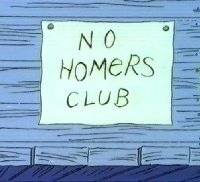
Homer the Great is S6E12 of the Simpsons. It has an iconic scene in which Homer recalls a childhood memory where he is turned down entry into a treehouse. A gatekeeper eagerly accepts everyone except for Homer. When asked why, he points to a “No Homers Club” sign. In perfect comedic timing, Homer rebuts that they allowed another Homer into the treehouse. Without missing a beat, the gatekeeper says, “It says ‘No Homerssssssss. We’re allowed to have one.'”

This scene is incredibly funny because Homer sets up this story as everyone hates him and the world is against him. I think we’ve all felt that same anxiety and fear before. The extreme specificity of the example is so humorous, especially with the inclusion of an exception. I think we’ve all felt unfairly treated at one point or another in our lives and have looked at others in similar positions to only find different outcomes. It’s not easy explaining to people that life is not fair, especially if they perceive it to be unjustly or overtly unfair to themselves.

There are certainly times when life truly is unfair. But what can really be done about it? People like to believe the grass is greener on the other side, but most often the case is that everything has its pros and cons. We can seek different environments or different friends, but problems tend to follow us if we don’t resolve them. We can make changes to the things around us and we can make changes to ourselves.

It’s funny because we say the only thing we can count on is change, but there’s some things that never change. The episode Homer the Great is not only iconic with its infamous meme, but also because it ends the same way Homer recounts his childhood, with another No Homers Club created in his dishonor. The storytelling and humor are so fantastic because they relate to the human experience and because we find ourselves in the same problems we had as a child, with almost cartoonish exaggeration.

While it’s certainly possible the world is out to get you and an existential crisis can be so overwhelming, what we can do is control ourselves and our decisions, which plays out into controlling and creating our future. Don’t let patterns of the past define your future and don’t let the perceived antagonists stop you from changing yourself and your future.