
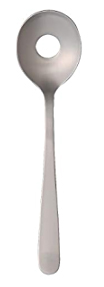
When I was in the 1st or 2nd grade, I remember something called the gifted program. Students were pulled aside from class and sent into a separate class room, for all the gifted students. Schools have this by varying names, but the idea was all the same. I remember doing random lessons or exercises and one stuck with me in particular. The teacher laid out a thought experiment and drew a ladle on the board with a large hole in it. She asked the class that if we were presented with this spoon, how would we go about eating a bowl of soup if presented to us.
Keep in mind we were young students. Kids to my left would say find a different spoon. Kids to my right would say fix the hole. I remember being so dubious of their solutions as a young child. How are you fixing this hole? Where are we finding other spoons? Is the point of this thought experiment to see how creative we are or how realistic we are?
After a couple of the raised hands had responded, I put my hand in the air and hesitantly responded. “Well, I know Americans don’t really do this. But you can just drink straight from the bowl.” There was audible disgust from some children. Ewwwww.
The teacher didn’t bat an eye. She welcomed my solution just as she did with all the other ones she had heard before. I felt a bit embarrassed by my classmate’s responses. I defended myself with, “I’m not saying I do this. I heard it’s the Japanese way.” Kids are kids, they didn’t really understand.
When class ended, a boy came up to me and looked me in the eye. “That’s disgusting. I don’t care if you’re Chinese or Japanese, you don’t do that at the dinner table.” I was shocked. I was embarrassed before and he had the patience to tell me in private after class. I was speechless. I tried repeating that I don’t drink straight from the bowl. But he walked away.
In hindsight, this story is a bit of a tragedy on the white boy who told me this, as I can only imagine he was mirroring behavior once directed at him. At the time, I saw it as a tragedy of revealing a part of Asian identity to the classroom. I couldn’t distance myself from what I had explained, whether I was Chinese or Japanese. At that age, kids ask what kind of Asian you are and luckily I could respond Chinese, as it was at least a large enough country on the map we could point it out and their parents could recognize us as a distinct Asian race.
But compromising my Chinese identity with my American identity was a complete loss for me. I remember, growing up, specifically keeping things to myself about my family and their culture, as if it were some kind of secret. In reality, Chinese people, or maybe just my parents, are some of the most boring people you could ever find. They like to work and stay at home. They were the first in their families to come to America and now they’re living the American dream.
Until my high school years, my parents did have small gatherings and dinners and I would play with other Chinese children. That world was some kind of dream subculture, where we were clearly American children living under Chinese cultures. We spoke English to each other, had varying skill levels of Chinese, and varying commitments to traditions and foods. We never were really able to express to each other our Chinese American journey, besides relaying stories of Chinese school, a typical Saturday tradition for Chinese Americans, and the rare story of American integration in school, like being asked about Chinese food.
It’s shocking how ingrained it was in me as a child and in the other children to be so silent about our assimilation into American culture. I don’t say this with defeat or pity either, because I love being American and growing up in America. I’ve visited China and seen how children grow up there and I’m not envious. I say it rather as a silent sadness, as an adult sorrowfully feels nostalgia, that we were not able to understand or communicate to each other that we were suppressing a part of our identity. Now that globalism and culture permeation has spread much further, things I once had difficulty explaining to my white friends, such as foods or customs, are now much more approachable and sometimes even asked by them without prompt.
Just like other aspects that have become more main stream, such as anime stickers on cars or Pokemon merch on young and old, expressing and embracing our unique identities becomes easier as the generations go by. I’m thankful for the progress, like seeing Asian role models in media, and I’m grateful for the future ahead of us. May there be more integration and may we celebrate what makes us unique. Cheers.
 Leadership, Design, Writing