
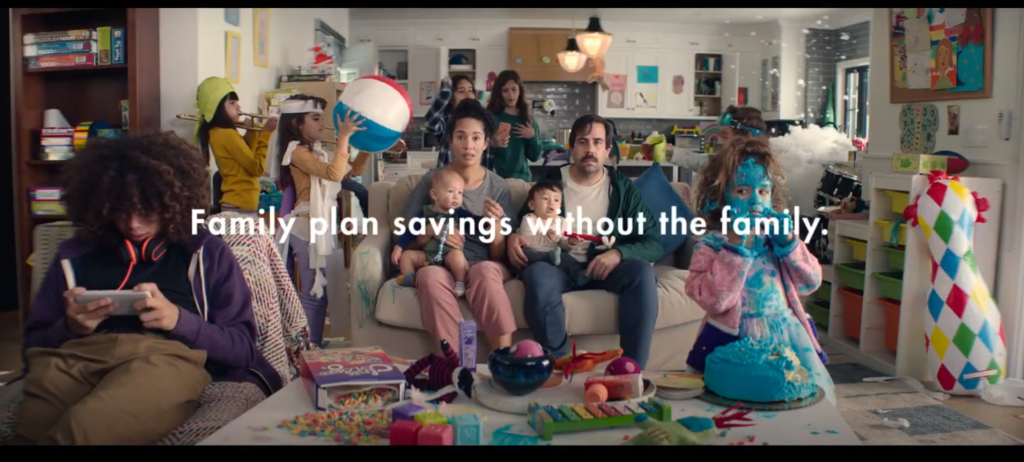
Yesterday my neighbor had the television on while I was visiting. A commercial came on, something that I’m not particularly used to as primarily an internet user. It’s great to get a pulse on what the market is selling and what the market thinks of its customers.
It was a cellphone commercial for Visible. Visible is some sort of independent partner of Verizon. Looking them up, they are:
an American mobile virtual network operator (MVNO) owned by Verizon Communications.
Wikipedia
While it’s interesting on its own to go into the rabbit hole of what an MVNO is or how companies like Visible partner up with Verizon, I wanted to touch on Visible’s targeting approach. Their approach is to target individuals, offering plans that have discounted rates without the need for buying a family package. This niche targeting is only possible once a market speaks up about its need, usually in the form of shying away from larger, bulkier, family packages.
The first thing I joked about when seeing this commercial was that this marketing strategy would never work in Asia, as everyone is close with their family and there would be immense guilt shaming for moving away from the family, let alone the family cellphone plan.
As a Chinese American, I of course think about the duality between the East and the West, and how different our values are especially when it comes to collectivism versus individualism. I thought nothing more of this observation of mine aside that individualism was indeed a defining characteristic of the West.
What I didn’t expect was to stumble upon this reddit thread this morning covering the article, The State of American Friendship: Change, Challenges, and Loss. The first line of the reddit thread title is: [Today I learned] more than 1 in 10 Americans have no close friends.
The article is actually quite in depth, with multiple parameters and graphs. The article addresses things like the pandemic, gender differences, number of friends, satisfaction of friendship, childhood friends, best friends, emotional support, and politics. The article compares data from 1990 to 2020. Although it is indeed a 30 year range (don’t make me feel old), I’d like to see further back a generation and see how the effects have trended since then. I suspect things like the internet as a whole, smartphones and social media, and globalization or urbanization led to a less quantity of in-person interactions as a whole, which led to overall less quality social interaction, and all of these catalysts are rather modern.
To my surprise, in the reddit comments was a fantastic discussion on the breakdown of the third place and why it may be the culprit to our modern loneliness. When I first learned of this phrase in high school, I was taught Starbucks and all other coffee places were attempting to become the third place, the place were people hang out most outside of home or work.
[Loneliness is caused] in part due to the breakdown in civil organizations such as churches, clubs, etc. combined with the distancing caused by social media and technology.
reddit user
I thought the comment to be quite profound, as communities do seem to have collapsed or segregated farther the more our political and digital divide separates us. More profound was an analysis by another commenter replying:
One of the reasons the show Cheers was so profoundly popular in the 1980s was because generations of Americans were mourning, whether they realized it or not, both the death of (and the crass capitalization of) the third place.
another reddit user
He cites the book Bowling Alone: The Collapse and Revival of American Community. I’ll have to check out the book. In modern days, the capitalization of public spaces and the intense focus on individual liberties has alienated us from each other. Commenters suggest that our car is the most appropriate winner of the title of third place, with us spending so much time commuting or using our car as a second room. In California, it’s so typical for people to hang out in cars, to take naps or have sex, or to just sit idle in park. I’d argue the most apt third place we have is our smartphone, hooking us into what Aziz Ansari coined as our “phone world.”
None of these aptly fit the definition of a third place, as they are intensely private and definitely not neutral. Where we are willing to spend our money and where we are intensely private lies the intersection of an echo chamber. And that is the tragedy of the death of the third place. When we lose our ability to convene on neutral territory, we lose our ability to engage in conversations we may not want to be a part of. And when we lose our first contact with contentious ideas, we lose all ability to approach or engage at all.
Individualism has incredible benefits. As always, in a future post I’ll cover more about individualism and collectivism, as well as expand on themes of loneliness. To read more on an incredible reddit comment about third places and Cheers, here’s the thread.
 Leadership, Design, Writing
2 thoughts on “Loneliness and Individualism”